

The notion of topological compactness has emerged in mathematics as an extraordinarily fruitful and robust concept at the center of diverse topological phenomena, unifying and explaining widespread results and observations in real analysis, topology, and far beyond. Let us investigate compactness as it may arise in the context of the surreal numbers.
Please enjoy this latest installment in my series of essays on the surreal numbers. Find the other surreal-number essays in the tag surreal-numbers, including my gentle introduction to this fantastical structure in The Surreal Numbers.
To recall the main concept, a set C in a topological space is said to be compact, if every open cover of C admits a finite subcover. That is, whenever 𝒰 is a collection of open sets and every point of C is an element of some U ∈ 𝒰—this is what it means for 𝒰 to be an open cover of C—then there is a finite subcover, meaning that there are finitely many sets in the collection U0, ..., Un ∈ 𝒰 that already cover C by themselves: C ⊆ U0 ∪ ··· ∪ Un.
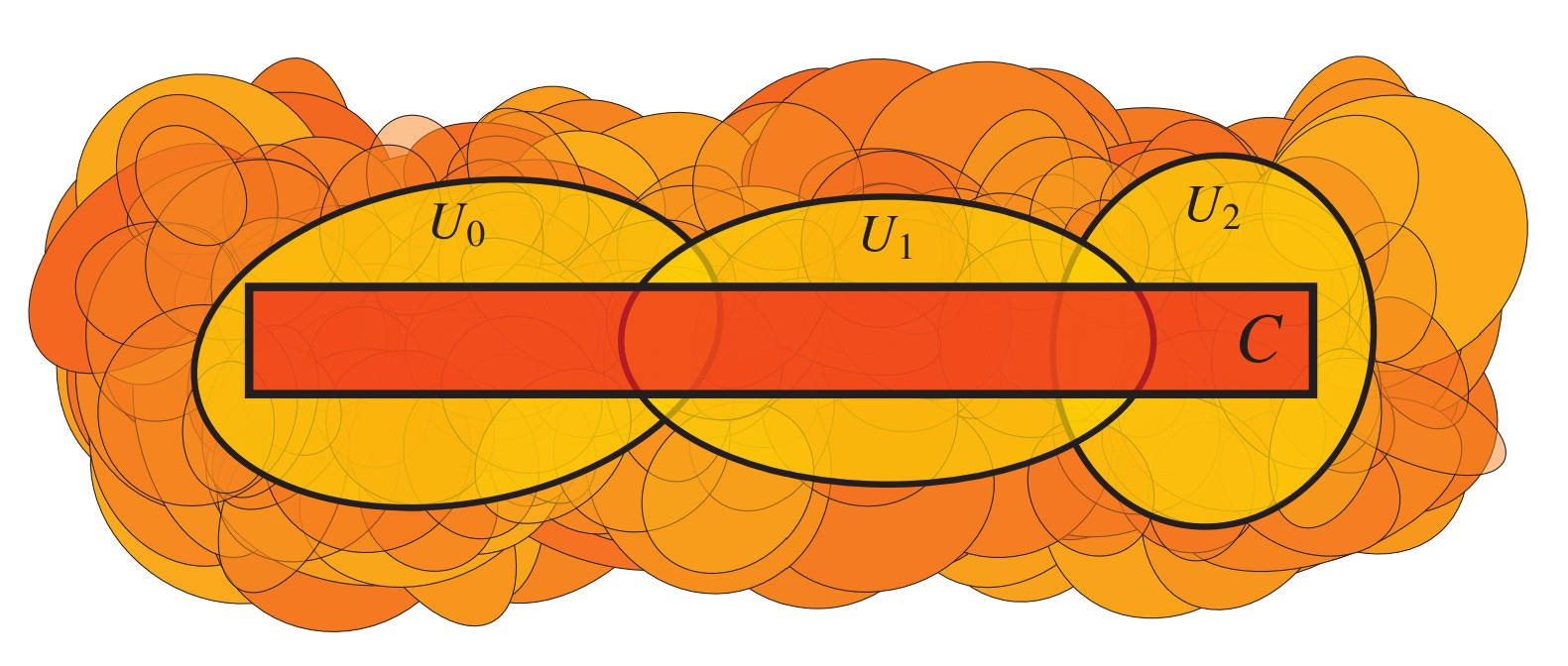
For those who have not studied it before, perhaps this may seem to be a rather esoteric technical property for a set C to have—why should we care about this finite subcover property? Well, the answer is that mathematicians have found this notion again and again at the center of diverse mathematical phenomena. It comes up in the distinction between continuity and uniform continuity, the extreme value theorem, the property of topological normality, and many other situations. Compactness distills the essence of separate arguments on these topics, and it turns out that the compactness property itself directly implies the desirable topological features in these and many other cases. Thus, compactness is a unifying, explanatory notion. One may adopt a philosophical perspective on the matter, taking compactness to express an abstract form of finiteness—after all, every finite set is clearly compact. Like finiteness, the compactness of a space often enables a general transfer from local knowledge to the global counterpart. A typical example might be the fact that every continuous function on a compact set of real numbers is uniformly continuous—continuity is a local phenomenon, after all, and uniform continuity is global.
In light of this, it seems both natural and important to investigate the compactness phenomenon in the surreal line. How well do the compactness features of the real numbers carry over to the surreal numbers?
We shall find some surprises. To foreshadow, at first things will seem downright discouraging for any compactness phenomenon in the surreal numbers, since the naive approach to compactness in the surreal numbers will be an almost complete failure, yielding no nontrivial instances of compactness. And yet, upon reflection we shall hit upon an alternative, fruitful perspective, which will yield a robust collection of positive instances of compactness—all that would be expected or even hoped for. Indeed, more than expected! By the end of this essay I will present several surprising, even shocking instances of compactness in the surreal numbers.
Let’s get started.
